To the untrained eye, a long, intact cylinder of ash resting at the tip of a burning cigar is merely a parlor trick—a photograph captured for social media. But to the archivist, a structured stack of ash is a transcript. It is a visual record of the rolling chair, the uniformity of the bunching, and the exact moisture conditions of the humidor where it slept.
When we record our tastings, the physical geometry of the ash provides immediate, empirical data regarding construction and leaf maturity before the flavor profile even shifts.
The Anatomy of the Burn Line
As you monitor the foot of your cigar, look closely at the boundary where the leaf meets the flame. The crispness of this line tells a distinct historical story:
- The Razor-Thin Edge: A perfectly straight, microscopic burn line indicates flawless wrapper tension and optimal leaf fermentation. The essential oils are vaporizing evenly across the entire surface.
- The Halo Effect: A thin, slightly carbonized dark ring right behind the ash reveals a heavy concentration of natural sugars and oils trying to caramelize. This is common in deeply aged Maduros and dense Broadleaf wrappers.
- The Jagged Wake: A wandering, uneven burn line typically signifies a structural imbalance in the filler—often where coarser, slower-burning Ligero leaves have drifted away from the center of the roll.
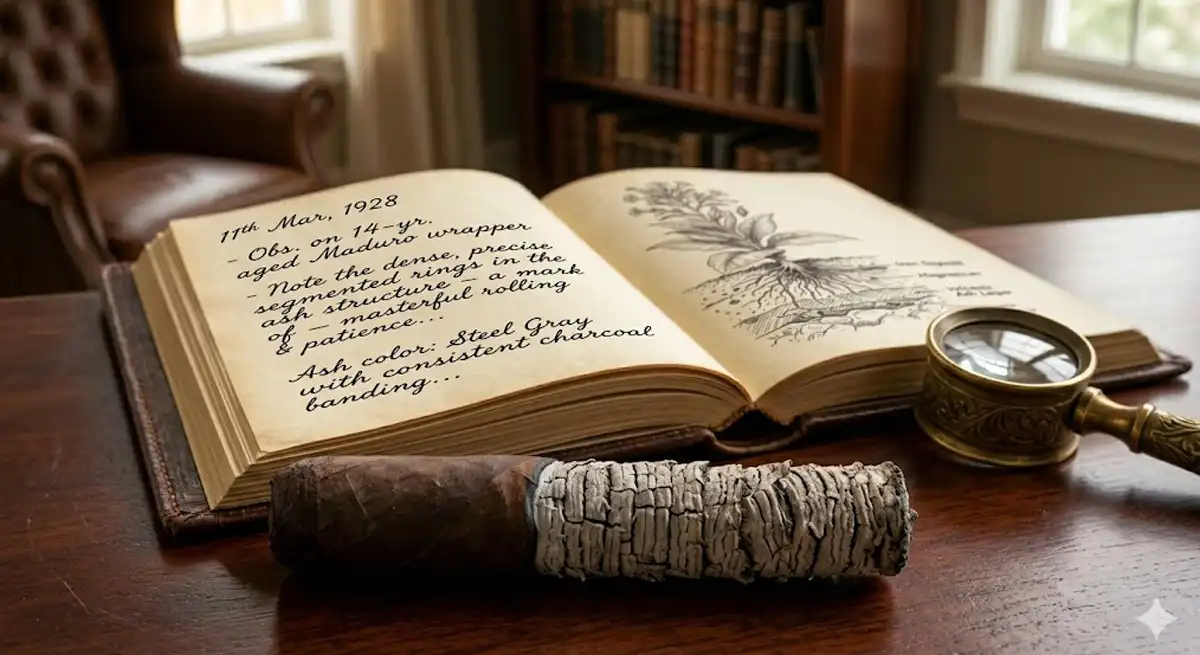
A dense, flaky ash that refuses to drop is the ultimate testament to a master torcedor. It proves that the long-filler leaves were folded like an accordion, creating unobstructed air channels that pull cooler air through the core.
Deciphering the Color Palette
When logging your observations in your journal, do not simply write "gray." True tobacco ash holds gradients that reveal the elemental makeup of the farm it left behind:
- Snow White: Indicates soil packed with magnesium and calcium. It is visually stunning but can sometimes lack the heavier earth tones of mineral-dense soils.
- Steel Gray and Charcoal: A classic sign of deep, mineral-rich volcanic soils. While it looks darker, it often delivers a more robust, iron-fueled finish on the palate.
- Black and Flaky: A warning sign. If the ash is dark black and crumbles instantly, the tobacco was likely under-fermented or holds excess moisture, resulting in a bitter, uneven burn.
The next time you sit down to document a blend, don't be quick to tap the foot against the glass. Let the ash build. Study its rings, measure its resilience, and read the timeline written in the carbon before it falls away.
— The Chronicler